Why did State Farm close nearly 4 in 10 wind roof claims without a payment? State Farm’s own paper gives part of the answer. In an internal summary dated October 26, 2021, prepared for a Senior Executive Offsite, the company put the ratio of wind claims closed without payment to claims reported at 39.5, up 17 points in one year. State Farm’s in-house lawyer wrote his concerns inside the draft. On October 26, 2026, Judge Amy Palumbo ruled the 19-page set is not privileged. On October 27, the homeowners filed all 19 pages in the public court record.
The numbers in State Farm’s own document
- The wind ratio for claims closed without payment hit 39.5, up 17 points in one year
- The hail ratio for claims closed without payment hit 39.3, up 13 points in one year
- Full roof replacements in Texas ran at a 63% frequency for Severity 3 wind and 90% for Severity 3 hail in the summary’s three-year baseline
- An Accenture benchmark in the draft put industry best replacement frequency at 5% to 10% on light wind and small hail claims
- Total roof replacements fell against partial repairs, from 3.21 to 1 in late 2020 to 1.95 to 1 in 2021
- The Hursh jury trial starts December 7, 2026, and this document set is now part of the public record
If your carrier closed your roof claim without a payment, or paid for a patch on a roof that still leaks, get a free claim review. Call 800.511.2240 and tell us what the letter said. We will read the estimate your carrier sent you and tell you plainly where your file stands.
What this document is
The set runs 19 pages, Bates HUR00158701-19. It opens with the claims director’s October 26, 2021 cover email to four colleagues, sending “the revised version of the summary for use at the SEO,” the Senior Executive Offsite. The pages hold the revised draft of a quality and service summary on fire claims roofs, an email chain between the director and two in-house lawyers, and an earlier draft carrying both lawyers’ comment bubbles, redlines, and in-line text.
The same set appears in several filings in the two Oklahoma cases. It went into the public record as part of the homeowners’ October 27, 2026 motion in Hursh.
This set is not the first State Farm paper to reach the public record. Our earlier breakdowns cover 31 unsealed court records and what they allege about claim denials and State Farm’s claims scorecard, where a falling roof replacement ratio counted as trending positively.
State Farm argued the set was protected as attorney-client privileged and work product. Judge Palumbo’s court minute finds the set “was not created in anticipation of litigation and is not protected work-product, nor attorney-client privileged.” The minute also records that “the request for a stay pending appeal is denied.” State Farm keeps its appellate rights. The ruling stands while any appeal runs.
Two limits belong on the record. The figures in the summary cover catastrophe and non-catastrophe claims together, across the country, on a rolling 12 months to September 2021. They are not Florida numbers and not Hurricane Isaias numbers. And some passages in the filed copy still carry “Redacted – AC” boxes, mostly in the lawyers’ emails.
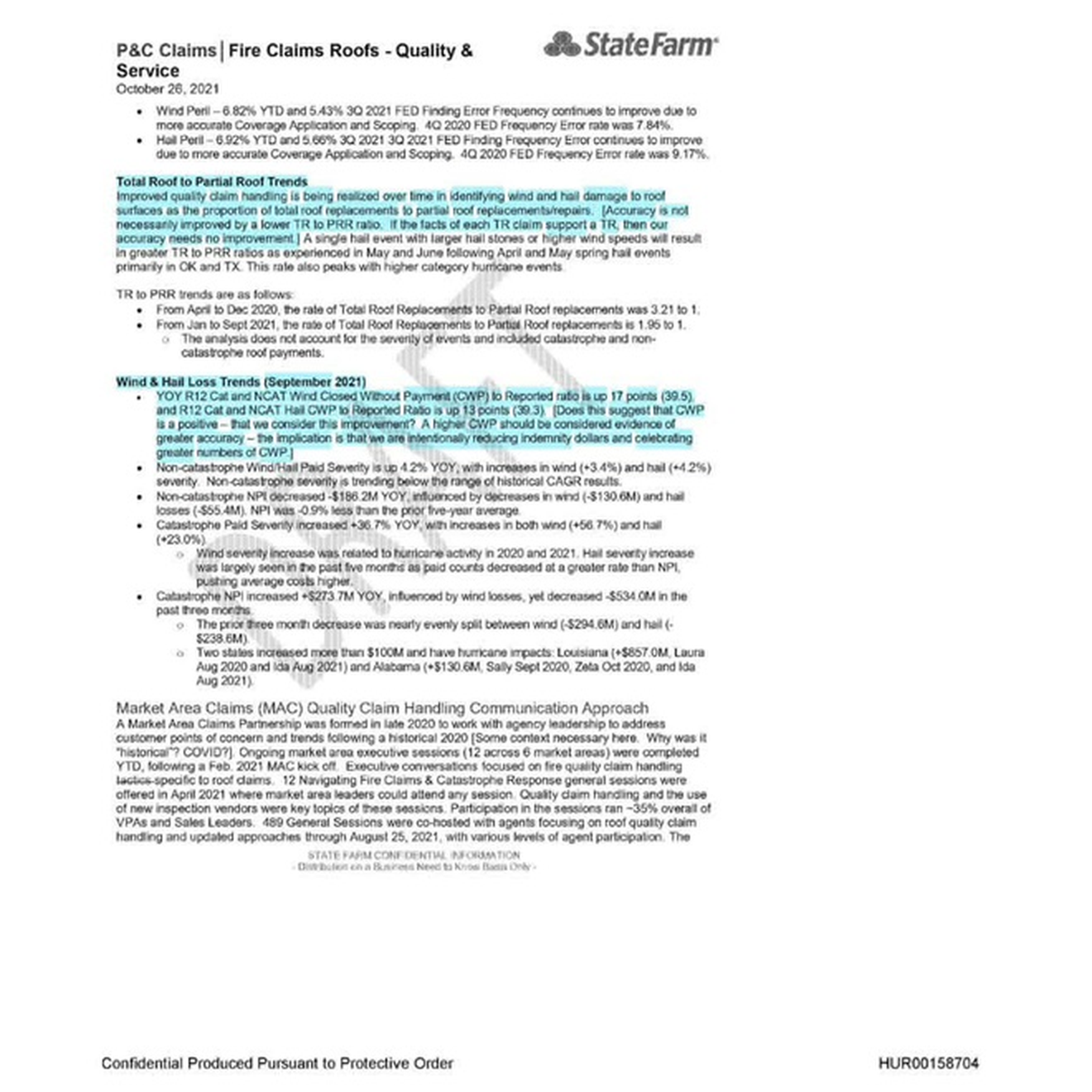
The summary is a quality review, and it also reported improving measures. Wind estimate error frequency ran 6.82 percent for 2021, down from 7.84 percent in the last quarter of 2020. Hail ran 6.92 percent, down from 9.17 percent. That context matters, and it makes the flagged items below harder to wave away. The hardest questions in this document were raised by State Farm’s own lawyer, in writing, in the margins.
Whose words are in the margins
The bracketed comments in the draft are not anonymous. In a sworn declaration filed October 5, 2026, one of State Farm’s in-house lawyers listed eight bracketed passages in the revised draft as his own comments. He said the lawyers’ role “was to apply legal judgment to particular language used in the draft” and that the comments “do not establish or direct the underlying claim handling practices.”
Keep the frame exact, because the two sides fight over it. State Farm calls the comments legal advice on wording. The homeowners call them admissions. Judge Palumbo ruled on one question only: the comments and the document are not privileged. Read the words below with that frame and judge them yourself.
A manager had to approve full roof replacements
New wind and hail action steps took effect in January 2021 for all states, after a six-month run in Texas. One step required claim team manager approval for full roof replacements for damage potentially caused by small hail and light wind.
The lawyer’s comment beside that step reads: “Caution should be exercised here. Our adversaries could say this places pressure on front line claim reps to not replace a roof.”
The edit history in the same passage shows care with the wording. The tracked changes turned “quality tactics” into “quality action steps,” and “tactic” into “step.” The approval rule is the document’s own text. The caution is the lawyer’s comment inside the draft, not final policy language. But the caution exists because State Farm’s own lawyer saw how the rule could land on the person standing on your roof.
“Industry standards are not our standard of performance”
The summary carried a Texas baseline. In its own words: “Analysis of 3-year data validated Full Roof Replacements were paid at 63% frequency for Severity 3 Wind and 90% frequency for Severity 3 Hail.”
The summary also states: “State Farm has been trending significantly above the industry the percentage of roof replacements for small hail and light wind, meaning we have been totaling more roofs than the other carriers across the insurance industry.”
The earlier draft put a benchmark next to that gap. It read: “Industry Best FRR on light wind and small hail averages a 5-10% frequency,” sourced to Accenture Consulting Services, with “an internal quality improvement opportunity of 53-58% for light wind and 80-85% for small hail.”
The lawyer’s comment on that bullet is the longest in the set. It reads, in part: ““Industry Best” does not necessarily mean replacing fewer roofs. Quality improvement should not be measured by reducing number of roof replacements. Other measures, such as estimates more closely matching reinspections, should be the measure.”
A second comment makes the same point against a different passage. Beside a plan to educate agents on “industry standards of reparability,” the lawyer wrote: “Again caution – industry standards are not our standard of performance. Paying what we owe on each claim is.”
In the earlier draft, beside a line about improving toward industry recognized standards, he wrote: “Our focus should be on improving accuracy of our estimates and damage assessments, not on getting closer to industry averages. We assess damage based on mertis of each claim.” The spelling “mertis” is the document’s own.
The summary itself repeats the standard the lawyer pointed to. It tells adjusting staff: “We are committed to diligently investigating, reasonably evaluating and acting promptly to resolve the claim to ensure the policyholders obtain all benefits available and provided by the insurance policy.”
The summary’s own 2021 surveys add one more fact. Targeted surveys reported 94 percent to 95 percent accuracy in scoping to repair or replace, and found that 5 percent to 6 percent of totaled roofs were not supported in the claim file, which the summary called an opportunity to improve.
The slide from replacement to repair
The summary tracked total roof replacements against partial roof replacements. The ratio ran 3.21 to 1 from April to December 2020, then fell to 1.95 to 1 from January to September 2021. Fewer full replacements. More partial repairs.
The lawyer’s comment pushed back on reading that slide as progress: “Accuracy is not necessarily improved by a lower TR to PRR ratio. If the facts of each TR claim support a TR, then our accuracy needs no improvement.”
In plain words, a replacement is accurate when the damage calls for a replacement. A falling replacement count proves nothing on its own. State Farm’s own lawyer wrote that down.
The question about closed claims
The trends section reported the rise in claims closed without payment. The lawyer’s comment on that section asks: “Does this suggest that CWP is a positive – that we consider this improvement?” The comment goes on: “A higher CWP should be considered evidence of greater accuracy – the implication is that we are intentionally reducing indemnity dollars and celebrating greater numbers of CWP.”
That is not an outside critic. That is a comment written by State Farm’s in-house lawyer, inside State Farm’s own summary, on State Farm’s own numbers, asking whether a rise in unpaid closures was being read as good news.
State Farm’s own agents were raising a matching concern from the field. The summary gathered agent themes: neighboring carriers replaced roofs where State Farm found no covered damage or found damage under the deductible, and reputable roofing contractors did not agree with State Farm’s damage findings.
First decisions get overturned
The summary states: “Some claim leaders are overturning initial roofing decisions leading to the conclusion overall claim handling decisions are inaccurate.”
It also notes that damage findings change “when engineers are engaged or appraisal provision pursued, creating a lack of confidence.”
Hold those two lines together. First decisions on roofs got overturned often enough that the summary tied the overturns to inaccurate handling. And the scope of damage itself changed once an engineer or the appraisal process entered the file.
One more number makes the point concrete. In the summary’s own count, 4.5 percent of roofs year to date moved from a closed without payment status to a total roof paid status. A claim closed with nothing later paid in full. Homeowners live both sides of that. The first answer is not always the right answer, and State Farm’s own summary said so.
A lawyer flagged the Unfair Claims Practices Act
One section listed what customers were telling State Farm. Customers did not know what to expect during the claim. They were confused by the inspection options. They wanted more frequent communication and follow-up.
The lawyer’s comment sits on those bullets, struck through in the draft. It reads: “These bullets potentially implicate Unfair Claims Practices Act, potentially. Can we claim Self-Evaluative Privilege on this document, and if so, let’s label this accordingly.”
Five years later, State Farm argued the full set should stay protected. The court ruled it should not. That ruling is why you can read these pages today.
What happens next in Hursh
The case is Billy and Lacy Hursh v. State Farm Fire and Casualty Co., in the District Court of Oklahoma County. The jury trial starts December 7, 2026. A hearing on summary judgment motions is set for November 13, 2026, with pretrial on November 19. The homeowners’ lawyers at Whitten Burrage represent nearly 1,000 Oklahoma policyholders in State Farm roof cases, per The Oklahoman.
This document reached the public record through a fight over the top of the company. On October 27, 2026, the homeowners moved to enforce the court’s September 1, 2026 order on the deposition of State Farm CEO Jon Farney, and filed this set with that motion. Their allegation, in their words, is that Farney “was presented with information that State Farm was intentionally reducing indemnity, putting pressure on front line claim reps not to replace roofs, and engaging in Unfair Settlement Practices Act Violations, yet did nothing to stop” the tactics. That is the homeowners’ allegation. State Farm had not responded to that motion as of October 28, 2026.
State Farm’s answer, from its own court filings, is direct. It states that it “never attempts to arbitrarily reduce total roof replacements or indemnity payments to meet industry standards.” State Farm denies the bad faith allegations in the case.
Update, November 9, 2026: In the Oklahoma litigation over these records, the Oklahoma Supreme Court denied State Farm’s emergency request to block public disclosure of the internal memo this article examines. State Farm then dropped its writ. The memo stays public. (Reporting: Rates of Wrath, November 6, 2026.)
What this means for your roof claim

How can you help me? If your claim closed without a payment, or the payment covered a repair on a roof that still fails, the first decision is not always the last word. The summary above shows first decisions getting overturned inside the carrier itself, and closed claims later paid in full. If your claim was denied or underpaid, read how to reopen a denied or underpaid Isaias claim in Florida.
What can you do? We read the estimate your carrier sent you, line by line. We document the damage at your property. We build the file and deal with the carrier for you.
Why you? This is the only side we work. A public adjuster represents the policyholder. The carrier’s adjuster represents the carrier. Nobody else in the process works only for you.
How do you make my life easier? You hand us the denial letter and the estimate. We handle the calls, the paperwork, and the follow-up. You get straight answers on where the file stands.
How do you get me the most the policy owes? We push for the full amount owed under the terms and conditions of your policy, not the first number the carrier picked. You pay a percentage of what we recover, and only when we recover it. 10 percent of nothing is nothing.
Questions homeowners ask us
My claim closed without payment. Is it over?
Not always. Carriers overturn their own first decisions, and State Farm’s own summary counts closed claims that later moved to full roof payments. Bring us the denial letter and the estimate, and we will tell you whether the file can move.
The carrier paid for a repair and my roof still leaks. What now?
A partial payment is not the end of a claim. The damage can be documented again and the file pushed back with proof.
What does the review cost?
The review itself costs nothing. You pay only when we recover for you.
The bottom line
A denial letter is one person’s first decision. State Farm’s own summary, and its own lawyer’s comments inside it, show how often first decisions change once a file gets a harder look. Your file can get that harder look, with the damage documented this time.